Pilgrimage Guide — Talakadu
Talakadu: A Town a Queen Cursed Into Sand
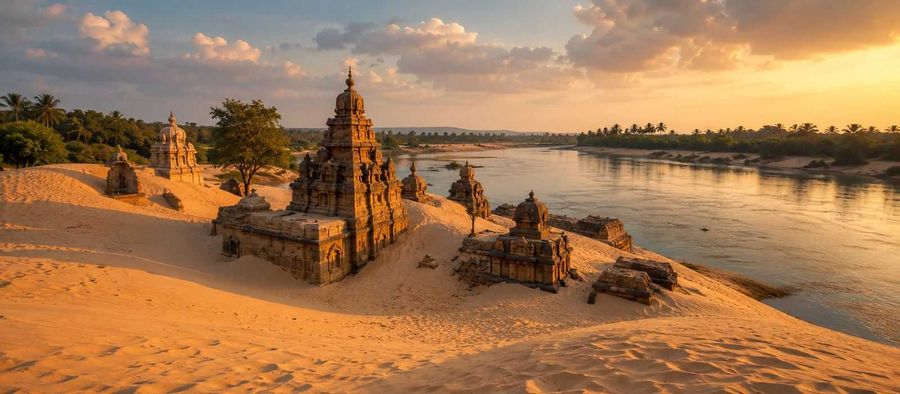
Over 30 temples, most still buried beneath shifting dunes — the result, tradition says, of a queen's dying curse. Geologists have a different theory. We'll give you both.
Illustrative AI image of the region.
About This Destination
Talakadu is an ancient town on the banks of the Kaveri River, once the capital of the Western Ganga dynasty from roughly 350 to 999 CE. Over 30 temples once stood here, built across the Western Ganga, Chola, and Hoysala periods — most now buried beneath sand dunes that continue to shift. It's genuinely one of Karnataka's more unusual destinations: part pilgrimage site, part open historical mystery.
The Curse — and Two Legends, Not One
In 1610, Alamelamma, wife of the Vijayanagara viceroy Srirangaraya at Srirangapatna, was pursued by the Mysore Wodeyar king's forces over her jewels after her husband's death. Rather than surrender them, she drowned herself in the Kaveri at a spot called Malangi, uttering a curse in Kannada: that Talakadu would become sand, Malangi would become a whirlpool, and the Wodeyar kings would never have direct heirs. Local tradition credits this curse with the town's burial.
Geologists offer a different explanation, worth knowing alongside the legend. Shifts in the Kaveri's course, sediment deposits from a nearby weir, seasonal flooding, and shifting wind patterns are all cited as natural causes for the sand's gradual accumulation over centuries. Both explanations are widely discussed side by side — we're not asserting either as the definitive answer, just giving you both.
A separate, older legend explains the town's name itself. Two hunters, Tala and Kada, are said to have accidentally struck a tree while hunting, causing it to bleed — inside, they discovered Lord Shiva concealed in the trunk, and healed his wound. Shiva became known as Vaidyeshwara, "physician-lord," for being healed by the hunters, and the town's name Talakadu is believed to derive from Tala and Kada themselves.
What is the curse of Talakadu?
In 1610, Alamelamma, wife of the Vijayanagara viceroy Srirangaraya at Srirangapatna, was pursued by the Mysore Wodeyar king's forces over her jewels after her husband's death. Rather than surrender them, she drowned herself in the Kaveri River at a spot called Malangi, uttering a curse: that Talakadu would become sand, Malangi would become a whirlpool, and the Wodeyar kings would never have direct heirs. Local tradition credits this curse with Talakadu's burial under sand dunes.
Is there a scientific explanation for Talakadu's sand dunes?
Yes — geologists point to natural causes, including shifts in the Kaveri River's course, sediment deposits from a nearby weir, seasonal flooding, and wind patterns gradually depositing sand over centuries. Both explanations, the legend and the geology, are widely discussed side by side; we present both rather than asserting either as the definitive answer.
What is the legend behind the town's name and the Vaidyeshwara temple?
According to tradition, two hunters named Tala and Kada struck a tree while hunting, and blood flowed from the wound. They discovered Lord Shiva concealed within the tree and healed him — earning Shiva the name Vaidyeshwara, meaning 'physician-lord.' The hunters themselves are said to have become immortal. The town's name, Talakadu, is believed to derive from the names of these two hunters.
The Panchalinga Temples
Five Shiva temples — Vaidyeshwara, Maruleshwara, Arkeshwara, Mallikarjuna, and Pataleshwara — represent the five faces of Shiva and sit at the centre of the Panchalinga Darshana, a pilgrimage held roughly once every 12 years, on a new moon Monday in the Karthika month when the sun is in the Scorpius constellation.
The Pataleshwara Lingam
Said to change colour through the day — red in the morning, black by afternoon, white by evening — a genuinely distinctive physical detail unique to this shrine.
Keertinarayana Temple
A Hoysala-style Vishnu temple built at the behest of Sri Ramanujacharya under King Vishnuvardhana — successfully excavated and restored, unlike much of the rest of the town.
The Panchalinga Darshana follows a specific ritual sequence: pilgrims bathe in the Gokarna theertha, worship Gokarneswara and Chandikadevi, then Vaidyeshwara, bathe again at the river's northeastern, southern, and western stretches, worship Arkeshwara, Pataleshwara, Maruleshwara, and Mallikarjuna in turn (returning to Vaidyeshwara after each), and conclude at the Keertinarayana temple — all traditionally completed within a single day.
What is the Panchalinga Darshana?
A pilgrimage held roughly once every 12 years, on a new moon Monday in the Karthika month when the sun is in the Scorpius constellation, involving a specific ritual sequence across five Shiva temples — Vaidyeshwara, Maruleshwara, Arkeshwara, Mallikarjuna, and Pataleshwara — representing the five faces of Shiva. Pilgrims bathe in the Kaveri at specific points between temple visits, concluding at the Keertinarayana temple.
Where to Stay
Talakadu's riverside setting draws genuinely good backwater resorts, not just pilgrim lodges — a nicer stay situation than some of the smaller Malnad pilgrimage towns on our list.
Jaladhama Resort3-star, backwater setting, water activities, Ayurveda spa
The River Club (Rayaa)Riverside getaway en route to Talakadu
Nijaguna Resorts & Spa3-star, ~19km from Talakadu
Do you need assistance in booking these hotels? Do let us know.
Nearby
Talakadu's own legend runs directly through Srirangapatna — Alamelamma's husband was viceroy there, tied to the Sri Ranganatha temple she sent her jewels to every week. Worth reading that story alongside this one.
Continue Planning Nearby
Srirangapatna — the town at the heart of Alamelamma's own storyRead guide
Shivanasamudra Falls — same broader Kaveri riverside regionRead guide
Is there a KSTDC tour that covers Talakadu?
Not among the two South Karnataka coastal-and-Malnad pilgrimage tours we track, since Talakadu sits in a different region entirely, closer to Mysuru. It's genuinely well-suited to a day trip from Mysore or Srirangapatna, both of which are close by.