Hampi: A Lost Capital You Can't Rush
Once among the richest cities on Earth, spread across 40 sq km of temples, palaces, and boulder-strewn hills — this is the guide to seeing it properly, not just photographing the stone chariot.
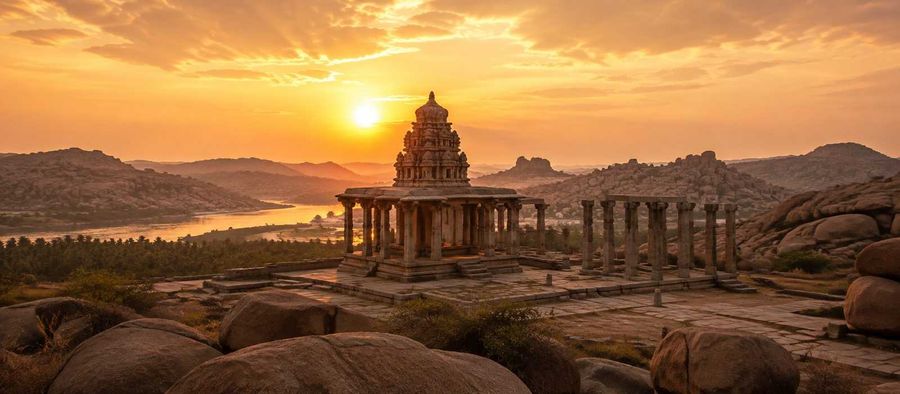
Hampi
Illustrative AI image of the region.
The Monuments — What Not to Miss
Hampi was, by the 14th to 16th centuries, one of the largest and wealthiest cities in the world — capital of the Vijayanagara Empire, sometimes described as rivalling Rome in its heyday. Today it's a UNESCO World Heritage Site, often called the world's largest open-air museum. Two days is the realistic minimum to see it properly; a single day leaves you exhausted with little time to actually absorb what you're looking at.
The site splits broadly into two zones: the Sacred Centre (temples and religious sites) and the Royal Centre (palaces and administrative structures) — worth treating as two separate outings rather than one rushed circuit.
Virupaksha Temple
The oldest functioning temple in the Sacred Centre, dedicated to Shiva, with a history dating to the 9th-10th century and a 160-foot gopura marking the entrance. Still an active place of worship, not a ruin.
Vittala Temple & Stone Chariot
Hampi's most iconic monument — the stone chariot appears on India's ₹50 note. Built in the 15th century, the complex also features 56 musical pillars that produce different notes when tapped.
Lotus Mahal & Elephant Stables
Part of the Royal Centre, showing clear Indo-Islamic architectural influence — symmetrical arches and domes, a departure from the Dravidian style seen at the temples.
Royal Enclosure
The administrative and ceremonial heart of the empire, including the King's Balance (Tulapurushandana) where kings were once weighed against gold and gems for charitable distribution.
Queen's Bath
An ornate bathing pavilion for royal women, with arched corridors and balconies overlooking a sunken pool — one of the better-preserved secular structures.
Matanga Hill
A short trek for genuinely the best panoramic view of Hampi's boulder-strewn landscape — ruins, river, and city ruins laid out below. Best at sunrise or sunset.
Anjanadri Hill — Hanuman's Birthplace
Across the Tungabhadra from Hampi, near the ancient village of Anegundi, Anjanadri Hill is believed to be where Hanuman was born to his mother Anjana — hence the name, and hence Hanuman's other name, Anjaneya. A Vijayanagara-era temple sits at the summit, reached by a climb of roughly 500-600 steps. Even setting aside the religious significance, the climb rewards you with genuinely panoramic views over Hampi's ruins, the paddy fields, and the river below — arguably one of the best viewpoints in the entire region.
GI Heritage — Crafts Born From Hampi Itself
This isn't a generic "Karnataka has GI products" mention — both of these trace directly back to Hampi's own imperial history.
Kinhal Toys (GI-Tagged)
A wooden craft tradition that began when the Vijayanagara rulers themselves invited artisans to their capital at Hampi. Those craftsmen, later settled at nearby Kinhal, are the same lineage responsible for much of the wooden and mural artwork still visible on Hampi's own temples today.
Hoovina Hadagali Mallige (GI-Tagged Jasmine)
Grown in the same Vijayanagara district as Hampi, this jasmine historically supplied flowers for imperial rituals at this very capital — a genuine agricultural thread connecting the empire's daily religious life to what's still farmed in the region today.
Tickets, Timing & Getting Around
Hampi/Kamalapura or Hosapete — Where Should You Stay?
Choose Hampi/Kamalapura if this is a short, heritage-heavy trip and you want to reduce daily transfer time to the monument area. Choose Hosapete (Hospet) if a wider hotel choice, restaurants, railway connectivity and town conveniences matter more. If you want Hampi plus a nature/wildlife dimension, a stay toward the Daroji side serves a different purpose again.
Where to Stay — Two Genuinely Different Options
Hotel Mayura Bhuvaneshwari — closest to the heritage core
Set in Kamalapura, about 1km from the main sites — a short drive from the Archaeological Museum, Queen's Bath, and Royal Enclosure, and near the Hanuman Temple. Multiple room categories are offered, along with a restaurant and bar; current room inventory should be checked for the travel dates. Guest reviews are mixed on maintenance, as is common with older government-run properties, so treat it as a practical, well-located base rather than a luxury stay.
View This KSTDC HotelHampi Heritage & Wilderness Resort — heritage plus wildlife
Set at the edge of the Daroji Sloth Bear Sanctuary, roughly 15km from the sanctuary itself — a genuinely different combination from a standard heritage hotel. Rustic, thatched-roof cottages, guided nature treks, and the option to spot sloth bears alongside your ruins sightseeing. A good pick if wildlife is part of what draws you here, not just history.
View This JLR PropertyNearby Destinations
Hampi sits within easy reach of Karnataka's other major Chalukyan and heritage sites.
Anegundi, just across the Tungabhadra River from Hampi, is genuinely older than Hampi itself — it served as the Vijayanagara Empire's first capital before Hampi took over that role, and local tradition identifies it as Kishkindha, the mythical monkey kingdom of the Ramayana, ruled by Sugriva and, before him, Vali. The name itself means "elephant pit" in Kannada, tied to local lore that this was where the empire's war elephants were kept and bathed. Beyond Anjanadri Hill (already covered above), Anegundi has its own quieter sites worth a wander — the Ranganathaswamy Temple, Gagan Mahal palace, Anegundi Fort, and the black-stone Huchappayana Matha Temple near the river.
Traditionally, Anegundi is reached by a coracle (a small round boat) across the river near the Vittala Temple — a genuinely memorable, low-cost crossing — or by road via a bridge further along, a roughly 19-20km drive around. Unlike the ruins-heavy pace of Hampi itself, Anegundi retains a slower, rural character — paddy fields, coconut groves, and a living village rather than a monument circuit, worth an afternoon on its own terms.
Already Have Dedicated Guides
Badami, Aihole, and Pattadakal are commonly combined as a single circuit given their shared Chalukyan-era architecture — see our dedicated Badami guide for how to sequence a visit to all three.