Gokarna: A Temple Town With a Beach Problem It Doesn't Have
Most people come for the beaches and skip the temple, or vice versa. Genuinely worth doing both — the Atmalinga's mythology is as rich as the five-beach trek is scenic.
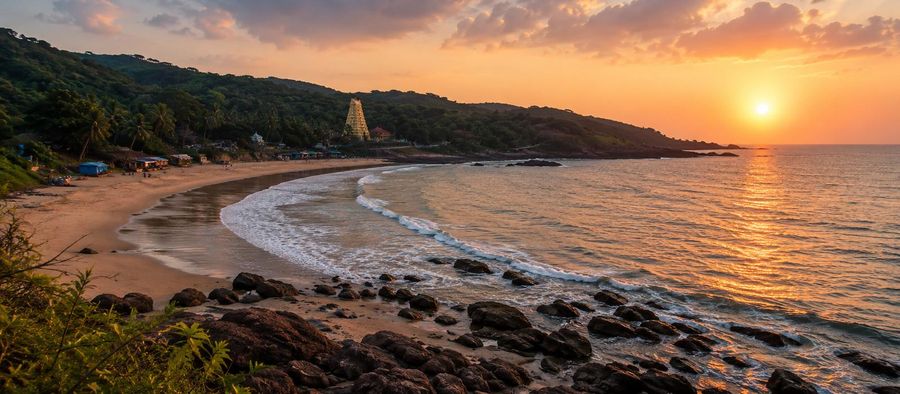
Gokarna
Illustrative AI image of the region.
Is Gokarna the Right Trip for You?
Gokarna genuinely works as two different trips layered into one — a serious Shaiva pilgrimage town, home to one of Karnataka's most significant temples, and a laid-back, bohemian beach-trekking circuit that's been drawing backpackers for decades. Most visitors lean toward one side or the other; the ones who do both tend to leave with the fuller picture of what makes this coast distinctive.
Mahabaleshwar Temple — the Atmalinga
Gokarna's spiritual weight comes from a specific object: the Atmalinga, a self-manifested Shiva lingam that, according to legend, Ravana obtained through fierce penance at Mount Kailash — only to be tricked by Ganesha into setting it down here, after which it became immovable. The name Gokarna itself comes from this story: as Ravana tried desperately to lift the lingam, he grabbed the ear ("karna") of a cow ("gow") sinking into the ground nearby.
Dakshina Kashi
The temple is regarded as second in sanctity only to Kashi Vishwanath in Varanasi, earning Gokarna the title "Dakshina Kashi" — the Kashi of the South. It's also one of Karnataka's seven Muktisthalas, sites considered auspicious for final rites.
The Five-Temple Circuit
A roughly 3km walking pilgrimage within the town itself — Mahabaleshwar, Maha Ganapati, Bhadrakali, Tamra Gauri, and Sajjeshwar — traditionally completed barefoot before noon.
The Wider Panchalinga Yatra
A larger regional pilgrimage circuit connecting Gokarna to Sajjeshwar, Dhareshwar, Gunavanteshwar, and Murudeshwar — the five sites where fragments of the Atmalinga's coverings are said to have landed.
Real, Dated History
Chhatrapati Shivaji visited the temple in 1665 after disbanding his forces here — a specific, documented event, not folklore. The temple's Dravidian granite structure has been enhanced across centuries since its earlier foundations.
The Five-Beach Trek
This is the other half of Gokarna's identity — a chain of five beaches connected by coastal trails, genuinely one of South India's best-known beach-hopping routes. There's no single "correct" direction; most people start from either Kudle or Paradise depending on which end they want more daylight at.
Gokarna Main Beach Road access
The town beach itself, closest to the temple — a natural starting or ending point.
Kudle Beach Road access
Popular for shacks, sunsets, and a livelier backpacker scene than the town beach.
Om Beach Road access
Naturally shaped like the Om symbol — genuinely, not a marketing description — and the most popular starting point for the trek onward.
Half Moon Beach Trek/boat only
About 30 minutes' trek from Om Beach, named for its crescent shape — quieter and less commercial.
Paradise Beach Trek/boat only
The most secluded of the five, with a long-standing reputation as a hippie/backpacker haven since decades past.
Where to Stay
Om Beach Resort — an honest look
Colonial-style suite rooms set in greenery close to the Mahabaleshwar Temple, with a pool, Ayurveda centre, and Gol Ghar dining. Worth knowing upfront: despite the name, it's not directly on the beach — it sits about 1.4km away, and guests are typically driven to Kudle and Om Beach by resort jeep as part of the stay. Reviews are genuinely mixed: some guests describe spacious rooms and excellent food, others flag an older, unevenly maintained property with stairs that aren't ideal for elderly guests or anyone with joint issues.
View Om Beach Resort